Blogs actualizados recientemente:
Aún no tienes usuario?
RegístrarseCita
Carolina
Cita
Cristina2
Me gustan los dibujitos......
Muy setenteros...
Salu2

Cita
Cristina2
Cita
Carolina
Cita
Cristina2
Me gustan los dibujitos......
Muy setenteros...
Salu2
me estás llamando vieja quizá?





Cita
Madlogar
Os cuelgo esto, espero que le corrijais todo lo que se pueda:
Abilities: basic building blocks, depending on both genetic and learning factors, used in the development of skills (not synonymous with skills). For more discussion of abilities/skills see appendix II.
Habilidades: elementos básicos, que dependen de factores genéticos y de aprendizaje, utilizados en el desarrollo de aptitudes (no es sinónimo de [competencias] habilidades). Para una discusión más de las habilidades / capacidades véase el apéndice II.
Angulating: moving in the diagonal and/or lateral planes of the body in a flexing or extending fashion. When speaking of angulating and angulation, we imply bending or extending movements in the feet, knees, hips, spine, and any combination thereof.
Angulación: movimiento en el plano diagonal y / o lateral del cuerpo en forma de flexión o extensión. Cuando se habla angular y de angulación, implica movimientos de flexión o extensión de los pies, rodillas, caderas, columna vertebral, y cualquier combinación de éstos.
Motion of the body may be referred to the lateral (“side-to-side”) plane, anterior – posterior (“forward-backward”) plane or some combination thereof (The diagonal planes).
El movimiento del cuerpo puede referirse al plano lateral ("lado a lado", al plano anterior - posterior ("adelante-atrás"
Angulation is further defined in the mechanical analysis and explanation of appendix III.
La angulación se define en la explicación del el análisis mecánico del apéndice III.
Anticipating: a movement in preparation for turning, during which upper and lower body are brought into a twisted relationship. The consequently stretched muscles are quicker and stronger in contracting and causing movement.
Anticipación: movimiento de preparación [del giro] para el giro , durante el cual la parte superior del cuerpo se sitúa [torcida] rotada en relación a la inferior. En consecuencia los músculos se estiran y contraen rápidamente para contrarrotar causando el movimiento.
Mental anticipation for any action on skis precedes the physical execution of movements. Anticipating mentally creates eye movement which, in turn, becomes the connection to the physical implementation of the task.
La anticipación mental de cualquier acción sobre los esquís precede la ejecución física de movimientos. [anticipando mentalmente se crea in movimiento de los ojos que, a su vez, hace la conexión con implementación física de la tarea.] con la anticipación mental, movemos los ojos, cosa que se convierte en la conexión física para la ejecución del gesto.[[/b]/color]
NOTA Cowboy: Los "cojones". Eso es una parte, una gran parte, de acuerdo. Pero los ojos están en la cabeza y ésta esquiando se encuentra moviéndose contínuamente en varios planos, por lo que el cerebro anda un poco despistado. Ese acto de anticipación es muy complejo y debe "aprenderse", aunque buena parte es automático. Debido al movimiento y la altura de la cabeza las otras aportaciones en la anticipación y a modo de telemetría para conocer nuestra posición respecto a lo que nos rodea: tenemos los bastones que son las extensiones de nuestras manos y nos indican la posición en la que nos encontramos respecto del suelo (algo que tenemos muy interiorizado; supongo que parte es resto de cuando andábamos por las lianas, parte la manipulación fina + capacidad creativa). Y por último los pies que nos cuentan cómo está el terreno ( libro de Carolo ). Yo creo más en la combinación de éstos elementos, vista, tacto mano, tacto pie, oído interno (equilibrio) y la propiocepción.
When the torso and the legs twist, the hips play an intermediary role.
Cuando el torso y las piernas del giran, las caderas desempeñar un papel [mediador] de enlace .
Realizing that both muscle masses that are predominantly responsible for the rotation of the body connect to the pelvis (quadriceps from the legs and back and abdominal muscles from the torso), the skier finds that the “hips” are not associated totally with either the torso or the legs but (depending on the degree of muscle tension generated by the twisting movement) assume an intermediary role.
Al darse cuenta de que ambas masas musculares conectadas por la pelvis son mayoritariamente responsables de la rotación del cuerpo (Los cuadriceps de las piernas y la espalda y los músculos del abdomen forman el torso), el esquiador se encuentra con que la "cadera" no está totalmente asociada, ya sea con el torso o con las piernas, pero (en función del grado de tensión muscular generada por el movimiento de torsión) asume un papel de intermediario.
NOTA Cowboy He aquí el por qué me pongo siempre tan gilipollas con lo de nombrar lo de la cadera y por eso prefiero olvidarme de la cadera y hablar de pies, o de tronco, pero muy pocas veces hablo de cadera. Añado que cuando aquí se habla de movimiento de torsión tiene que ver con la rotación de la pierna para dar el giro. Es decir, imaginaros que andáis en giro corto en pendiente pronunciada, y que estáis en pleno cambio, por lo tanto posición alta y en extensión. Al "caer" para dar el giro, giráis rápido la pierna (rotación de fémur), a la vez que váis flexionando "progresivamente" pero más rápido q en giro ámplio. Esa rotación de la pierna, esa "patada" hacia adentro es el movimiento de torsión aquí nombrado y puede y debe ser muy potente. En el libro de RonLeMaster se habla de esto y en el libro blanco de Carolo (Esquí, Rendimiento y Emoción) también.
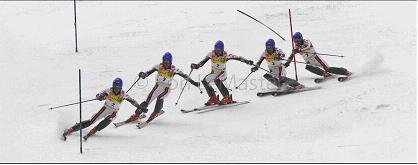
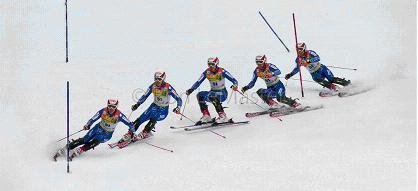
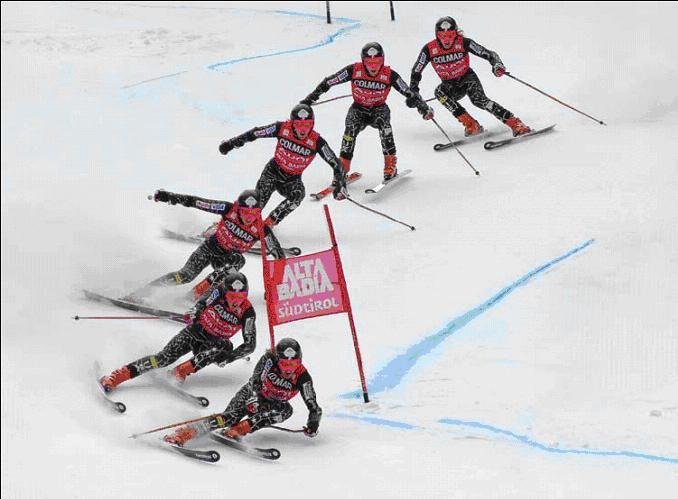
A skier can anticipate by twisting the torso toward the center of the intended turn, as is generally the case in longer radius turns or by turning the skis beneath the torso as is done in short radius turns. Usually both mechanisms interact to some extent, with one generally being dominant. Often, we will be able to see a movement toward anticipation made with sufficient momentum to “kick off” the turn with a touch of rotation.
Un esquiador puede anticipar girando el torso hacia el centro de la curva prevista, como se hace generalmente en el caso en las curvas de radio largo o girando los esquís debajo del torso, como se hace en las curvas de radio corto. Por lo general, ambos mecanismos interactúan en cierta medida siendo, generalmente, uno de ellos el dominante. A menudo, podremos ver un movimiento de anticipación con el impulso suficiente para “empezar” el giro con un poco de rotación.
NOTA Cowboy: Lo que vendría a resumirse más o menos en: giro largo acompaño con el tronco. Giro corto, dejo el tronco quieto a dirección a tomar, y muevo las piernas por debajo, de lado a lado.
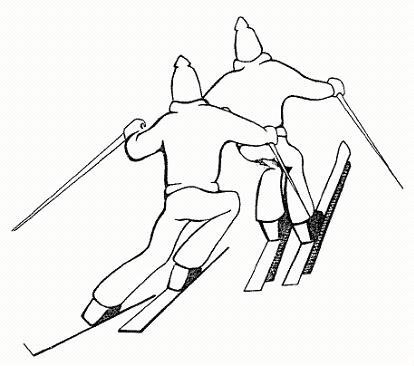
ATM: Abbreviation for the American Teaching Method. This term has been superceded by ATS (American Teaching System) which more accurately reflect the overall American approach to ski teaching.
ATM: Abreviación para el Método de enseñanza estadounidense. Este término ha sido reemplazado por ATS (Sistema de la Enseñanza estadounidense), el cual refleja con más precisión el enfoque general estadounidense hacia la enseñanza de esquí.
ATS: Abbreviation for the American Teaching System. ATS is to be understood as an entire teaching/learning system including the underlying philosophy, the mechanical movement progression required to facilitate learning how to ski. ATS is distinguished from most other teaching/learning system in that it rest strongly on humanistic, participatory teaching/learning philosophy.
ATS: abreviatura para el sistema de enseñanza estadounidense. ATS ha de entenderse como sistema completo de enseñanza / aprendizaje incluyendo filosofía base, la progresión mecánica del movimiento requerida para facilitar como aprender a esquiar. ATS se distingue, en gran medida, de la mayoría del resto de tipos de sistemas de enseñanza/aprendizaje en lo humanista, la filosofía participativa de la enseñanza/aprendizaje.
Balancing: the action of maintaining equilibrium. One may distinguish between static balance and dynamic balance.
Equilibrio: la acción de mantener el equilibrio. Se puede distinguir entre el equilibrio estático y equilibrio dinámico.
NOTA Cowboy: Superimportante. Es por estos detalles que ellos explican el esquí 646464696185666 veces mejor que nosotros. Son prácticos y cortan las cosas en los pedazos que haga falta, para que cualquiera lo entienda.
Static Balance refers to a state involving an equilibrium of forces while the person is not in motion. Dynamic balance refers to equilibrium while in motion.
El equilibrio estático se refiere al estado que implica un equilibrio de fuerzas mientras que la persona no está en movimiento. El equilibrio dinámico se refiere al equilibrio en movimiento.
Equilibrium means that the skier maintains desired posture, e.g., upright, while in motion down the hill. Conventionally, one speaks of balance and what should be understood here is the skill necessary to maintain a desired posture under different disturbances whether standing still moving slowly over smooth surfaces, or rapidly over rough, uneven snow.
Equilibrio significa que el esquiador mantiene la postura deseada, por ejemplo, erguido, mientras se mueve hacia abajo de la colina. [Convencionalmente] Normalmente, se habla de equilibrio y lo que debe entenderse aquí es la habilidad necesaria para mantener la postura que deseada en distintas perturbaciones ya sea de pie mientras se mueve lentamente sobre superficies lisas, o rápidamente sobre nieve áspera o desigual.
For more discussion of skills, abilities and balancing see Appendix II.
Banking: see inclining.
Banking: ver [de estabilidad] creo que se refiere a simlemente ver inclinación.
Blocking: the action of stabilizing the torso through pole contact with the snow, as performed in conjunction with the initiation of a turn.
Bloqueo: la acción de estabilización del torso a través del contacto del bastón con la nieve, se realiza en coordinación con el inicio del giro.
NOTA Cowboy: Lo que os contaba más arriba en el giro corto y dejar el tronco quieto apuntando a la dirección a tomar.
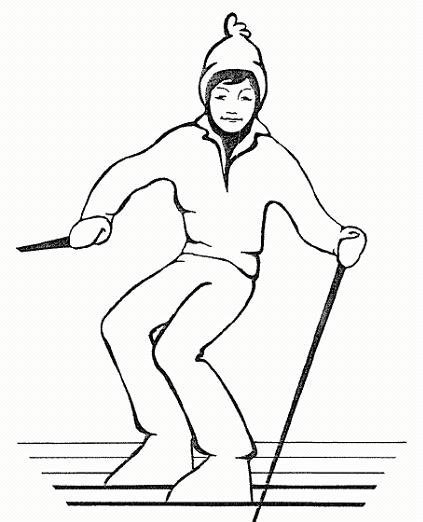
Blocking while skiing bumps or steep terrain may actually utilize a pole plant where the pole is temporarily stationary (i.e., planted). A skier may also be deflected away from the pole by making a dragging contact of the pole on the snow as would happened when skiing at high speeds of in deep snow.
[Bloqueando] El bloqueo se produce mientras se esquía en bañeras o en terreno escarpado en realidad utiliza la clavada de bastón cuando el bastón está temporalmente parado (es decir, plantado). Un esquiador también puede desviarse cuando el bastón hace contacto con la nieve arrastrándose, igual que sucede cuando se esquía a altas velocidades en nieve profunda.
Braking Wedge: a ski maneuver where the V-shaped positioning of the skis combined with the friction generated by the skis’ edges interacts with the slope to produce a slowing effects.
Frenado cuña: una maniobra de esquí, donde el posicionamiento en forma de V de los esquís en combinación con la fricción generada por los cantos de los esquís interactúa con la pendiente para producir un efecto [más lento] de frenado.
Braguage: the rotary movements of the legs required for (more or less) simultaneous pivoting of both skis; the (simultaneous) pivoting of both skis by leg action.
Braguage: los movimientos de rotación de las piernas necesarios para (más o menos) girar simultáneamente ambos esquís, el pivote (simultáneo) de ambos esquís por la acción de las piernas. Creo que es Bragaje pero bueno...
This term was introduced by G. Joubert and used to denote rotary movements of both legs as well as one leg only against the stabilization provided by the other leg (c.f. G. Goubert, Teach Yourself to Ski). In the U.S. this term has come to be associated with rotary movements of both legs, primarily in a wide track stance with both feet bearing weight.
Este término fue introducido por G. Joubert y se utiliza para referirse a los movimientos de rotación de ambas piernas, así como una sola pierna en contra de la estabilización proporcionada por la otra pierna (cf. G. Goubert, Aprendiendo a esquiar). En los EE.UU. este término ha llegado a ser asociado con movimientos de rotación de ambas piernas, sobre todo en una postura de vía ancha (pies separados) con los dos pies soportando el peso.
Carving: a turning of the skis with little lateral movement of the skis over the snow.
Tallando: un giro de los esquís con poco movimiento lateral de los esquís sobre la nieve.
NOTA Cowboy. Como diría un forero conocido, tallando no, pero el diccionario así lo quiere. Nosotros nos entendemos mejor si ponemos ahí "cortando".
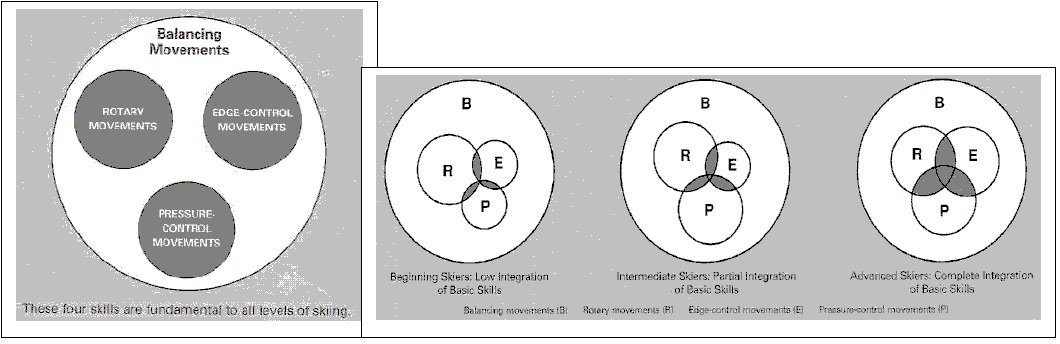
Skiing requires that the skier perform all of the functions illustrated in the following figure.
El esquí requiere que el esquiador realizar todas las funciones descritas en la figura siguiente.
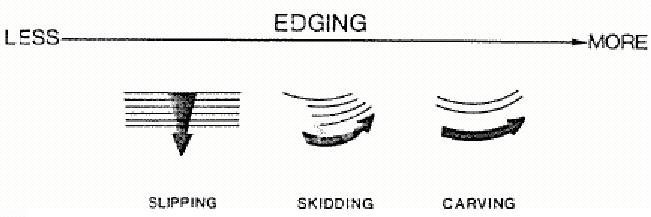
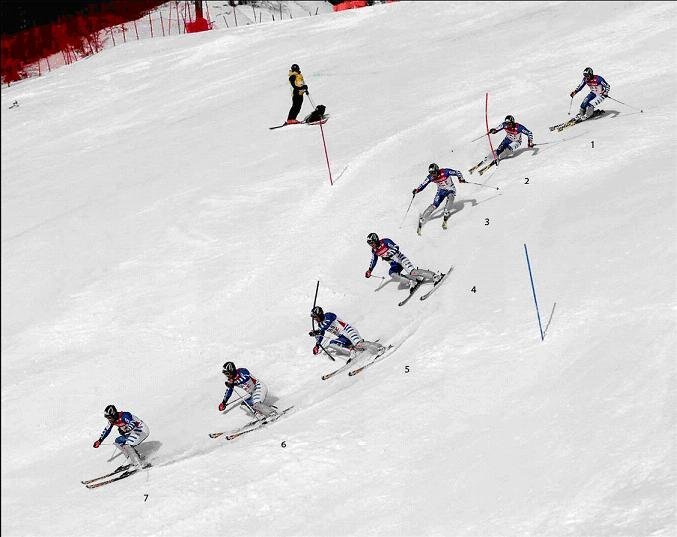
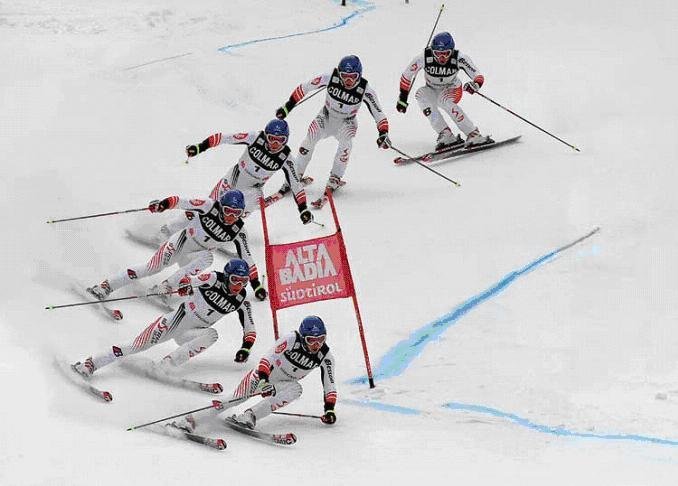
Because skiers, in reality, perform mostly skidded turns, we are making skidding the generic term for direction changes where the skis are in contact with the snow. If the skiers skid a lot, they may come closer to “slipping” the turns; if they skid less, they will come closer to “carving” their turns.
Debido a que los esquiadores, en realidad, realizan mayoritariamente giros derrapados, estamos haciendo de derrapar el término genérico para los cambios de dirección en los que los esquís están en contacto con la nieve. Si los esquiadores derrapan demasiado, pueden estar mas cerca de los giros deslizados, y si derrapan menos, estarán más cerca de los giros “Carving”.
Center Of Mass: (Also center of gravity [C.G.]) that the point of the skier’s body where, for analysis of skiing dynamics, all of the skier’s mass may be considered to reside. Usually this point is in the region of the navel: as the body flexes and assumes different postures, the CM moves around.
Centro de masas: (también centro de gravedad CG ) es el punto del cuerpo del esquiador donde, para el análisis de la dinámica de esquí, se puede considerar que reside toda la masa del esquiador. Por lo general, este punto está en la región del ombligo: a medida que se flexiona el cuerpo y asume posturas diferentes, el CM se mueve alrededor.
NOTA Cowboy: Alrededor es alrededor, incluso fuera o dentro. Es decir, en 3D.
Checking: the action of slowing or stopping a skidding of the skis on the snow.
Comprobación (control de velocidad): la acción de frenar o detener un deslizamiento de los esquís sobre la nieve.
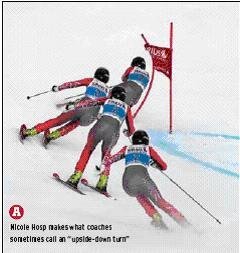
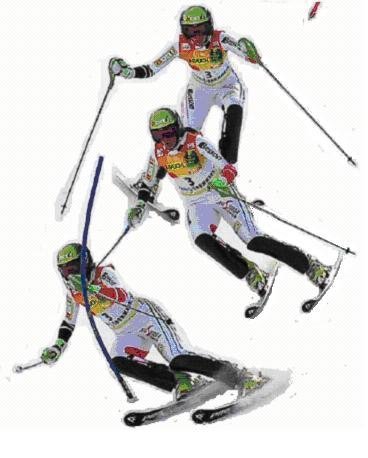
When linking turns, the skier usually “checks” by tightening the turn radius. The resulting rebound is used to enter a new turn. Checking can be done with only the outside ski (as it relates to the turn center) or with both skis.
Cuando (sobraba un la) encadenamos giros, por lo general el esquiador "controla" la velocidad ajustando el radio de giro. El rebote resultante se utiliza para iniciar un nuevo giro. El Control puede hacerse sólo con el esquí exterior (referido al centro de giro) o con los dos esquís.
HASTA AQUI LLEGE, AHORA ME VOY DE VACACIONES.....
ESPERO QUE SEA DE UTILIDAD, YO ALMENOS ESTOY APRENDIENDO BASTANTE TERMINOS EN INGLES
 Gracias.
Cita
Madlogar
Os cuelgo esto, espero que le corrijais todo lo que se pueda:
Abilities: basic building blocks, depending on both genetic and learning factors, used in the development of skills (not synonymous with skills). For more discussion of abilities/skills see appendix II.
Habilidades: elementos básicos, que dependen de factores genéticos y de aprendizaje, utilizados en el desarrollo de aptitudes (no es sinónimo de [competencias] habilidades/capacidades). Para una discusión más de las habilidades / capacidades véase el apéndice II.
Angulating: moving in the diagonal and/or lateral planes of the body in a flexing or extending fashion. When speaking of angulating and angulation, we imply bending or extending movements in the feet, knees, hips, spine, and any combination thereof.
Angulación: movimiento en el plano diagonal y / o lateral del cuerpo en forma de flexión o extensión. Cuando se habla angular y de angulación, implica movimientos de flexión o extensión de los pies, rodillas, caderas, columna vertebral, y cualquier combinación de éstos.
Motion of the body may be referred to the lateral (“side-to-side”) plane, anterior – posterior (“forward-backward”) plane or some combination thereof (The diagonal planes).
El movimiento del cuerpo puede referirse al plano lateral ("lado a lado"
Angulation is further defined in the mechanical analysis and explanation of appendix III.
La angulación se define en la explicación del el análisis mecánico del apéndice III.
Anticipating: a movement in preparation for turning, during which upper and lower body are brought into a twisted relationship. The consequently stretched muscles are quicker and stronger in contracting and causing movement.
Anticipación: movimiento de preparación [del giro] para el giro , durante el cual la parte superior del cuerpo se sitúa [torcida] rotada en relación a la inferior. En consecuencia los músculos se estiran y contraen rápidamente para contrarrotar causando el movimiento.
Mental anticipation for any action on skis precedes the physical execution of movements. Anticipating mentally creates eye movement which, in turn, becomes the connection to the physical implementation of the task.
La anticipación mental de cualquier acción sobre los esquís precede la ejecución física de movimientos. [anticipando mentalmente se crea in movimiento de los ojos que, a su vez, hace la conexión con implementación física de la tarea.] con la anticipación mental, movemos los ojos, cosa que se convierte en la conexión física para la ejecución del gesto.
NOTA Cowboy: Los "cojones". Eso es una parte, una gran parte, de acuerdo. Pero los ojos están en la cabeza y ésta esquiando se encuentra moviéndose contínuamente en varios planos, por lo que el cerebro anda un poco despistado. Ese acto de anticipación es muy complejo y debe "aprenderse", aunque buena parte es automático. Debido al movimiento y la altura de la cabeza las otras aportaciones en la anticipación y a modo de telemetría para conocer nuestra posición respecto a lo que nos rodea: tenemos los bastones que son las extensiones de nuestras manos y nos indican la posición en la que nos encontramos respecto del suelo (algo que tenemos muy interiorizado; supongo que parte es resto de cuando andábamos por las lianas, parte la manipulación fina + capacidad creativa). Y por último los pies que nos cuentan cómo está el terreno ( libro de Carolo ). Yo creo más en la combinación de éstos elementos, vista, tacto mano, tacto pie, oído interno (equilibrio) y la propiocepción.
When the torso and the legs twist, the hips play an intermediary role.
Cuando el torso y las piernas del giran, las caderas desempeñar un papel [mediador] de enlace .
Realizing that both muscle masses that are predominantly responsible for the rotation of the body connect to the pelvis (quadriceps from the legs and back and abdominal muscles from the torso), the skier finds that the “hips” are not associated totally with either the torso or the legs but (depending on the degree of muscle tension generated by the twisting movement) assume an intermediary role.
Al darse cuenta de que ambas masas musculares conectadas por la pelvis son mayoritariamente responsables de la rotación del cuerpo (Los cuadriceps de las piernas y la espalda y los músculos del abdomen forman el torso), el esquiador se encuentra con que la "cadera" no está totalmente asociada, ya sea con el torso o con las piernas, pero (en función del grado de tensión muscular generada por el movimiento de torsión) asume un papel de intermediario.
NOTA Cowboy He aquí el por qué me pongo siempre tan gilipollas con lo de nombrar lo de la cadera y por eso prefiero olvidarme de la cadera y hablar de pies, o de tronco, pero muy pocas veces hablo de cadera. Añado que cuando aquí se habla de movimiento de torsión tiene que ver con la rotación de la pierna para dar el giro. Es decir, imaginaros que andáis en giro corto en pendiente pronunciada, y que estáis en pleno cambio, por lo tanto posición alta y en extensión. Al "caer" para dar el giro, giráis rápido la pierna (rotación de fémur), a la vez que váis flexionando "progresivamente" pero más rápido q en giro ámplio. Esa rotación de la pierna, esa "patada" hacia adentro es el movimiento de torsión aquí nombrado y puede y debe ser muy potente. En el libro de RonLeMaster se habla de esto y en el libro blanco de Carolo (Esquí, Rendimiento y Emoción) también.
A skier can anticipate by twisting the torso toward the center of the intended turn, as is generally the case in longer radius turns or by turning the skis beneath the torso as is done in short radius turns. Usually both mechanisms interact to some extent, with one generally being dominant. Often, we will be able to see a movement toward anticipation made with sufficient momentum to “kick off” the turn with a touch of rotation.
Un esquiador puede anticipar girando el torso hacia el centro de la curva prevista, como se hace generalmente en el caso en las curvas de radio largo o girando los esquís debajo del torso, como se hace en las curvas de radio corto. Por lo general, ambos mecanismos interactúan en cierta medida siendo, generalmente, uno de ellos el dominante. A menudo, podremos ver un movimiento de anticipación con el impulso suficiente para “empezar” el giro con un poco de rotación.
NOTA Cowboy: Lo que vendría a resumirse más o menos en: giro largo acompaño con el tronco. Giro corto, dejo el tronco quieto a dirección a tomar, y muevo las piernas por debajo, de lado a lado.
ATM: Abbreviation for the American Teaching Method. This term has been superceded by ATS (American Teaching System) which more accurately reflect the overall American approach to ski teaching.
ATM: Abreviación para el Método de enseñanza estadounidense. Este término ha sido reemplazado por ATS (Sistema de la Enseñanza estadounidense), el cual refleja con más precisión el enfoque general estadounidense hacia la enseñanza de esquí.
ATS: Abbreviation for the American Teaching System. ATS is to be understood as an entire teaching/learning system including the underlying philosophy, the mechanical movement progression required to facilitate learning how to ski. ATS is distinguished from most other teaching/learning system in that it rest strongly on humanistic, participatory teaching/learning philosophy.
ATS: abreviatura para el sistema de enseñanza estadounidense. ATS ha de entenderse como sistema completo de enseñanza / aprendizaje incluyendo filosofía base, la progresión mecánica del movimiento requerida para facilitar como aprender a esquiar. ATS se distingue, en gran medida, de la mayoría del resto de tipos de sistemas de enseñanza/aprendizaje en lo humanista, la filosofía participativa de la enseñanza/aprendizaje.
Balancing: the action of maintaining equilibrium. One may distinguish between static balance and dynamic balance.
Equilibrio: la acción de mantener el equilibrio. Se puede distinguir entre el equilibrio estático y equilibrio dinámico.
NOTA Cowboy: Superimportante. Es por estos detalles que ellos explican el esquí 646464696185666 veces mejor que nosotros. Son prácticos y cortan las cosas en los pedazos que haga falta, para que cualquiera lo entienda.
Static Balance refers to a state involving an equilibrium of forces while the person is not in motion. Dynamic balance refers to equilibrium while in motion.
El equilibrio estático se refiere al estado que implica un equilibrio de fuerzas mientras que la persona no está en movimiento. El equilibrio dinámico se refiere al equilibrio en movimiento.
Equilibrium means that the skier maintains desired posture, e.g., upright, while in motion down the hill. Conventionally, one speaks of balance and what should be understood here is the skill necessary to maintain a desired posture under different disturbances whether standing still moving slowly over smooth surfaces, or rapidly over rough, uneven snow.
Equilibrio significa que el esquiador mantiene la postura deseada, por ejemplo, erguido, mientras se mueve hacia abajo de la colina. [Convencionalmente] Normalmente, se habla de equilibrio y lo que debe entenderse aquí es la habilidad necesaria para mantener la postura que deseada en distintas perturbaciones ya sea de pie mientras se mueve lentamente sobre superficies lisas, o rápidamente sobre nieve áspera o desigual.
For more discussion of skills, abilities and balancing see Appendix II.
Banking: see inclining.
Banking: ver [de estabilidad] creo que se refiere a simlemente ver inclinación.
Blocking: the action of stabilizing the torso through pole contact with the snow, as performed in conjunction with the initiation of a turn.
Bloqueo: la acción de estabilización del torso a través del contacto del bastón con la nieve, se realiza en coordinación con el inicio del giro.
NOTA Cowboy: Lo que os contaba más arriba en el giro corto y dejar el tronco quieto apuntando a la dirección a tomar.
Blocking while skiing bumps or steep terrain may actually utilize a pole plant where the pole is temporarily stationary (i.e., planted). A skier may also be deflected away from the pole by making a dragging contact of the pole on the snow as would happened when skiing at high speeds of in deep snow.
[Bloqueando] El bloqueo se produce mientras se esquía en bañeras o en terreno escarpado en realidad utiliza la clavada de bastón cuando el bastón está temporalmente parado (es decir, plantado). Un esquiador también puede desviarse cuando el bastón hace contacto con la nieve arrastrándose, igual que sucede cuando se esquía a altas velocidades en nieve profunda.
Braking Wedge: a ski maneuver where the V-shaped positioning of the skis combined with the friction generated by the skis’ edges interacts with the slope to produce a slowing effects.
Frenado cuña: una maniobra de esquí, donde el posicionamiento en forma de V de los esquís en combinación con la fricción generada por los cantos de los esquís interactúa con la pendiente para producir un efecto [más lento] de frenado.
Braguage: the rotary movements of the legs required for (more or less) simultaneous pivoting of both skis; the (simultaneous) pivoting of both skis by leg action.
Braguage: los movimientos de rotación de las piernas necesarios para (más o menos) girar simultáneamente ambos esquís, el pivote (simultáneo) de ambos esquís por la acción de las piernas. Creo que es Bragaje pero bueno...
This term was introduced by G. Joubert and used to denote rotary movements of both legs as well as one leg only against the stabilization provided by the other leg (c.f. G. Goubert, Teach Yourself to Ski). In the U.S. this term has come to be associated with rotary movements of both legs, primarily in a wide track stance with both feet bearing weight.
Este término fue introducido por G. Joubert y se utiliza para referirse a los movimientos de rotación de ambas piernas, así como una sola pierna en contra de la estabilización proporcionada por la otra pierna (cf. G. Goubert, Aprendiendo a esquiar). En los EE.UU. este término ha llegado a ser asociado con movimientos de rotación de ambas piernas, sobre todo en una postura de vía ancha (pies separados) con los dos pies soportando el peso.
Carving: a turning of the skis with little lateral movement of the skis over the snow.
Tallando: un giro de los esquís con poco movimiento lateral de los esquís sobre la nieve.
NOTA Cowboy. Como diría un forero conocido, tallando no, pero el diccionario así lo quiere. Nosotros nos entendemos mejor si ponemos ahí "cortando".
Skiing requires that the skier perform all of the functions illustrated in the following figure.
El esquí requiere que el esquiador realizar todas las funciones descritas en la figura siguiente.
Because skiers, in reality, perform mostly skidded turns, we are making skidding the generic term for direction changes where the skis are in contact with the snow. If the skiers skid a lot, they may come closer to “slipping” the turns; if they skid less, they will come closer to “carving” their turns.
Debido a que los esquiadores, en realidad, realizan mayoritariamente giros derrapados, estamos haciendo de derrapar el término genérico para los cambios de dirección en los que los esquís están en contacto con la nieve. Si los esquiadores derrapan demasiado, pueden estar mas cerca de los giros deslizados, y si derrapan menos, estarán más cerca de los giros “Carving”.
Center Of Mass: (Also center of gravity [C.G.]) that the point of the skier’s body where, for analysis of skiing dynamics, all of the skier’s mass may be considered to reside. Usually this point is in the region of the navel: as the body flexes and assumes different postures, the CM moves around.
Centro de masas: (también centro de gravedad CG ) es el punto del cuerpo del esquiador donde, para el análisis de la dinámica de esquí, se puede considerar que reside toda la masa del esquiador. Por lo general, este punto está en la región del ombligo: a medida que se flexiona el cuerpo y asume posturas diferentes, el CM se mueve alrededor.
NOTA Cowboy: Alrededor es alrededor, incluso fuera o dentro. Es decir, en 3D.
Checking: the action of slowing or stopping a skidding of the skis on the snow.
Comprobación (control de velocidad): la acción de frenar o detener un deslizamiento de los esquís sobre la nieve.
When linking turns, the skier usually “checks” by tightening the turn radius. The resulting rebound is used to enter a new turn. Checking can be done with only the outside ski (as it relates to the turn center) or with both skis.
Cuando (sobraba un la) encadenamos giros, por lo general el esquiador "controla" la velocidad ajustando el radio de giro. El rebote resultante se utiliza para iniciar un nuevo giro. El Control puede hacerse sólo con el esquí exterior (referido al centro de giro) o con los dos esquís.
HASTA AQUI LLEGE, AHORA ME VOY DE VACACIONES.....
ESPERO QUE SEA DE UTILIDAD, YO ALMENOS ESTOY APRENDIENDO BASTANTE TERMINOS EN INGLES
 Aquí, creo que como sinónimo le vendría bien "trigger" que podríamos traducir como detonante. Aunque es una patillada seguramente, pero es así como se entiende in spanish.
 Madlogar, donde dice "Hoping in ski boots" se refiere a saltar con las botas puestas
Cita
SnowCowboy
Description: Skier begins in a small gliding wedge and gradually increases the size to finish in a wedge stop.
Descripción: El esquiador empieza a deslizarse con una gran cuña y gradualmente incrementa el tamaño para finalizar parado en cuña.
NO!
Empieza a deslizarse con una cuña pequeña.
La idea "small gliding wedge", podríamos traducirlo por una cuña pequeña que nos permita deslizar. Es decir, esa cuña que todos tenemos en la cabeza.
Gliding wedge: cuña deslizada. Sort of...
Yo también ando liado y precisamente estoy haciendo inglés otra vez.
Se hará lo que se pueda.


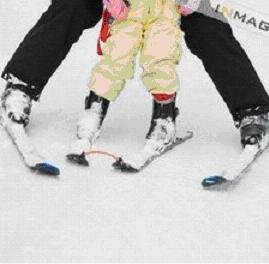
 De tus últimos posts, si me lo permites, un par de observaciones:
Cita
Nacho_vlc
Encomiable esfuerzo.
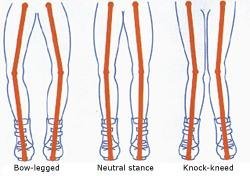
1. Keeping your body weight forward, bend your knees into each other in a knock-kneed stance.
1. Manteniendo su peso adelantado, doble sus rodillas entre si en una posición valga (hacia fuera)
Creo que es más correcto "hacia dentro, como si te arrodillaras". Para hacer cuña juntas las rodillas, no las separas hacia fuera. "Knock kneed stance" vendría a ser "posición arrodillada, uniendo las rodillas". Es lo bonito del inglés, que con dos palabros consiguen describir con mucha más precisión que nosotros...
3. Keep your weight off the tail of the uphill ski and slowly glide it parallel with the downhill ski. When you ski and use the stem christi, you come closer to advanced parallel skiing.
3.Mantengasu peso sobre la cola del esquí del monte y deslícelo lentamente paralelo al esquí del valle. Cuando esquía y usa el “stem Christi” esta mas cerca de esquiar en paralelo avanzado.
Se te ha pasado traducir el "off", que va con "keep". Es decir, no se trata de "mantener" el peso, sino de "sigue sin poner" el peso en la cola del esquí del monte. Fíjate que es lo que te pide el propio movimiento que está describiendo: para finalizar el giro y que el esquí del monte se ponga paralelo al del valle después de un giro, necesariamente has de aligerar peso en el esquí interior, o en lugar de acabar el giro estarías iniciando otro (bueno, un principiante haciendo este giro, si cambia el peso al monte de repente se va al suelo, más bien...)
Saludos

Rellena los siguientes campos para contactar con los editores del blog:
Si crees que la oferta es errónea, incompleta o induce a errores, por favor, háznoslo saber: